
Anne Limbourg, M.D., Assistant Professor
Board-Certified Specialist in Plastic and Aesthetic Surgery
A breast lift produces immediately impressive results. What many patients don’t realize, however, is that the longevity of these results isn’t determined by the skin sutures—but deep within the tissue, long before the wound is closed. Internal support structures are the key factor in whether a surgical result remains stable—or not.
In short: Internal support structures in mastopexy (breast lift) redistribute the mechanical load from the skin to deeper tissue structures. The most common methods involve fascial sutures made from the patient’s own tissue, as well as absorbable or permanent mesh materials. Which technique is appropriate depends on the individual tissue findings—and cannot be answered in general terms.
Classic mastopexy corrects the shape and position of the breast by removing excess skin and repositioning the breast tissue. This works—but there is a mechanical weakness: When the entire task of support is left to the skin alone, that skin bears a constant load.
Skin is elastic, but it cannot withstand static stress. Under constant mechanical tension—caused by the weight of the breast tissue and gravity—it stretches over the years. The result: The repositioned tissue begins to sag again, more quickly than with a procedure that includes deep support structures.
The basic principle of every internal support structure is the same: the mechanical load is shifted from the skin to deeper, mechanically more resistant structures—to fascia, scar tissue, or implanted materials.
The skin now serves only a covering function, not a supporting one. This protects the skin, reduces tension on scars, and improves the long-term stability of the result—especially in patients with large breast volume, reduced skin elasticity, or a pronounced initial condition.
The term “internal bra” does not describe a single surgical technique, but rather a surgical concept: the creation of a permanent internal support structure that holds the breast tissue in its new position. Functionally, the goal corresponds to what a well-fitting bra does externally—only from the inside, permanently, and invisibly.
Depending on the surgeon and the patient’s condition, an Internal Bra can be created using fascial sutures alone, mesh materials, or a combination of both approaches. What all variants have in common: The breast tissue is no longer simply lifted and sutured in place—it is mechanically anchored.
An Internal Bra concept is particularly relevant when:
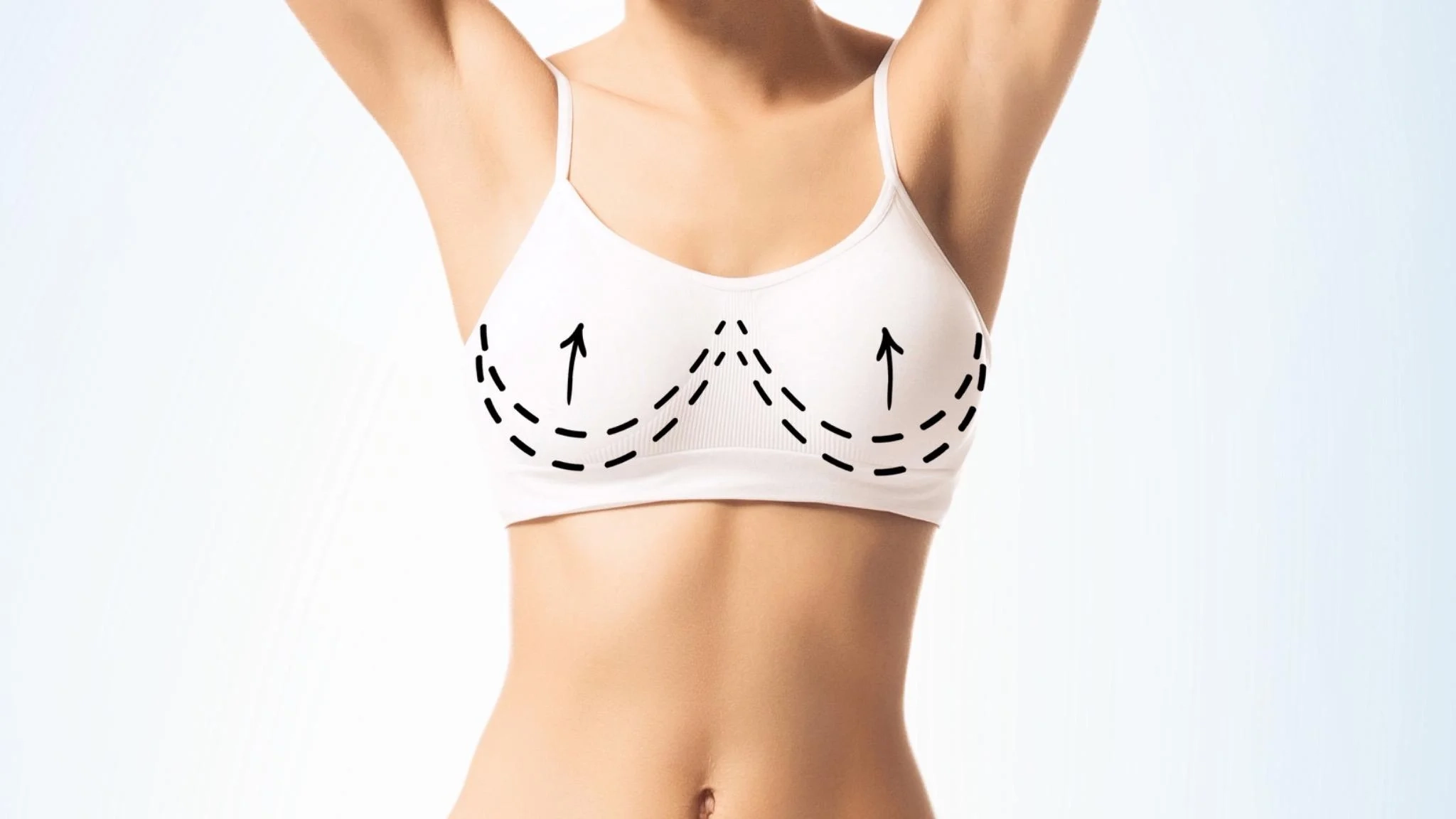
Fascioplasty is the oldest and most widely used method for internal breast stabilization. Fascia are tight connective tissue sheaths that envelop muscles and structures. In the breast area, the superficial fascia of the pectoralis major muscle—the large chest muscle plate—serves as the primary anchor point.
In this technique, the repositioned breast glandular tissue is fixed to this fascia using deep, permanent, or long-term absorbable sutures. The parenchyma—the actual glandular tissue—is shaped, gathered, and anchored in its new position. The sutures act like an internal corset that defines and maintains the shape from within.
The key advantage: no foreign material is introduced. This means no risk of a foreign body reaction, no material incompatibility, and no permanently implanted object. Fascial tissue is mechanically more resilient than skin and provides a reliable anchor point—provided it is present in sufficient quality.
This is precisely where the limitations of this method lie: In cases of severe ptosis, following significant weight loss, or when fascial tissue is severely reduced due to aging, the body’s own structure alone cannot always provide the desired support. In these cases, supplementary materials may be considered.
Absorbable meshes—such as those based on PGLA (polyglycolic acid-lactic acid copolymer)—are completely broken down by the body within a few months to a few years. During this time, they provide mechanical support to the breast tissue and allow the surrounding tissue to form its own scar tissue, which takes over the supportive function after resorption.
The principle is similar to that of a scaffold: it is only needed until the structure itself is stable. With appropriate indications and careful patient selection, absorbable meshes yield promising clinical results—with the advantage that no permanent foreign material remains in the body.
Permanent mesh materials—such as those made of polypropylene or other biocompatible polymers—provide consistent, long-term mechanical support. They are primarily considered when maximum support is required: in cases of severe pathology, following multiple prior surgeries, or when the body’s own tissue does not allow for reliable fascial anchoring.
The use of permanent meshes requires careful assessment of the indication. The complication profile is more specific than with absorbable materials and must be fully taken into account in the decision-making process.
A third option is acellular dermal matrices (ADM)—biological scaffold structures made from decellularized tissue, often from bovine or porcine sources. They are biocompatible, are partially integrated by the body, and leave no synthetic material behind. In aesthetic surgery, they are primarily used in complex revision cases where neither autologous fascia nor synthetic mesh represents the optimal solution. ADMs are significantly more expensive than synthetic meshes but offer biological advantages in specific indications.
The available clinical literature—including several prospective studies with follow-up periods ranging from two to five years—consistently shows that mastopexies with internal stabilization have lower recurrence rates than purely skin-based procedures. The nipple position remains more stable, ptosis returns more slowly, and patients with large glandular volume benefit particularly significantly.
In particular, the use of absorbable meshes in combination with fascial sutures demonstrates good long-term results in selected patient groups—with a favorable balance between supportive effect and foreign body burden.
No surgical procedure is without risk—and this also applies to internal support structures. With synthetic materials, particularly permanent meshes, the following complications are clinically relevant:
Fascial suture techniques have the lowest complication rate, as no foreign material is introduced. Absorbable meshes fall in the middle range. The frequency of all the complications mentioned depends heavily on the surgeon’s experience, patient selection, and the quality of postoperative care.
There is no universally superior technique. The decision for or against an internal support structure—and which type to use—is always an individual assessment. The decisive parameters are:
At Dr. Limbourg’s practice, this decision begins during the initial consultation—with a thorough clinical examination that goes far beyond simply assessing the degree of ptosis. We assess tissue quality, fascial structure, volume, and skin elasticity. Only on this basis do we develop a concrete surgical plan.
We explain all options transparently: which technique we consider appropriate for your specific condition, what the associated advantages and disadvantages are—and why we have reached this assessment. Only in this way can a well-informed, jointly supported decision be made.
What is an “internal bra” in breast lift surgery? An internal bra is not a single product, but a surgical concept: sutures and/or mesh materials are used to create an internal support structure that permanently holds the lifted breast tissue in its new position—similar to a bra, but from the inside and permanently.
Is mesh used in every breast lift? No. If the patient has good natural fascial tissue and moderate ptosis, a fascial plasty alone may be sufficient. Mesh materials are primarily considered in cases of severe ptosis, reduced tissue quality, or revision surgeries. The decision is made on an individual basis based on the clinical findings.
How long do the results of a breast lift with an internal support structure last? Studies show that internal support structures improve long-term stability compared to purely skin-based techniques—especially in cases of larger glandular volume. However, an exact prognosis is not possible, as the result depends on tissue quality, body weight, hormonal status, and lifestyle.
Can an implanted mesh be removed later? Permanently implanted, non-absorbable meshes can be surgically removed, though this involves surgical intervention. Absorbable meshes are broken down by the body on their own and do not need to be removed. Biological matrices (ADM) are partially integrated into the body’s tissue.
Which support structure does Priv.-Doz. Dr. Limbourg recommend? There is no one-size-fits-all recommendation. The appropriate technique is determined by the individual findings—the degree of ptosis, tissue quality, volume, and the patient’s preference regarding foreign materials. We explain all options in a detailed initial consultation and provide a transparent rationale for our assessment.
The quality of a breast lift isn’t just evident on the day of surgery—it becomes apparent three, five, and ten years later. Internal support structures are the key factor in determining whether the results remain stable or whether gravity eventually takes its toll over time. Choosing the right technique is not a standard decision, but rather the result of a thorough, individualized analysis.
At Dr. Limbourg’s practice, we take the time this analysis deserves—drawing on clinical experience from over 5,000 breast surgeries, an academic background, and an honest assessment that truly helps you.
Whether you’re looking for a change, a correction, or a fresh start—we’ll take the time to listen to you. During a one-on-one consultation, we’ll work together to determine what’s possible and what’s truly right for you. We’ll approach this with empathy, honesty, and as equals. Schedule your consultation today at our practice in Hanover.