05.11.2026
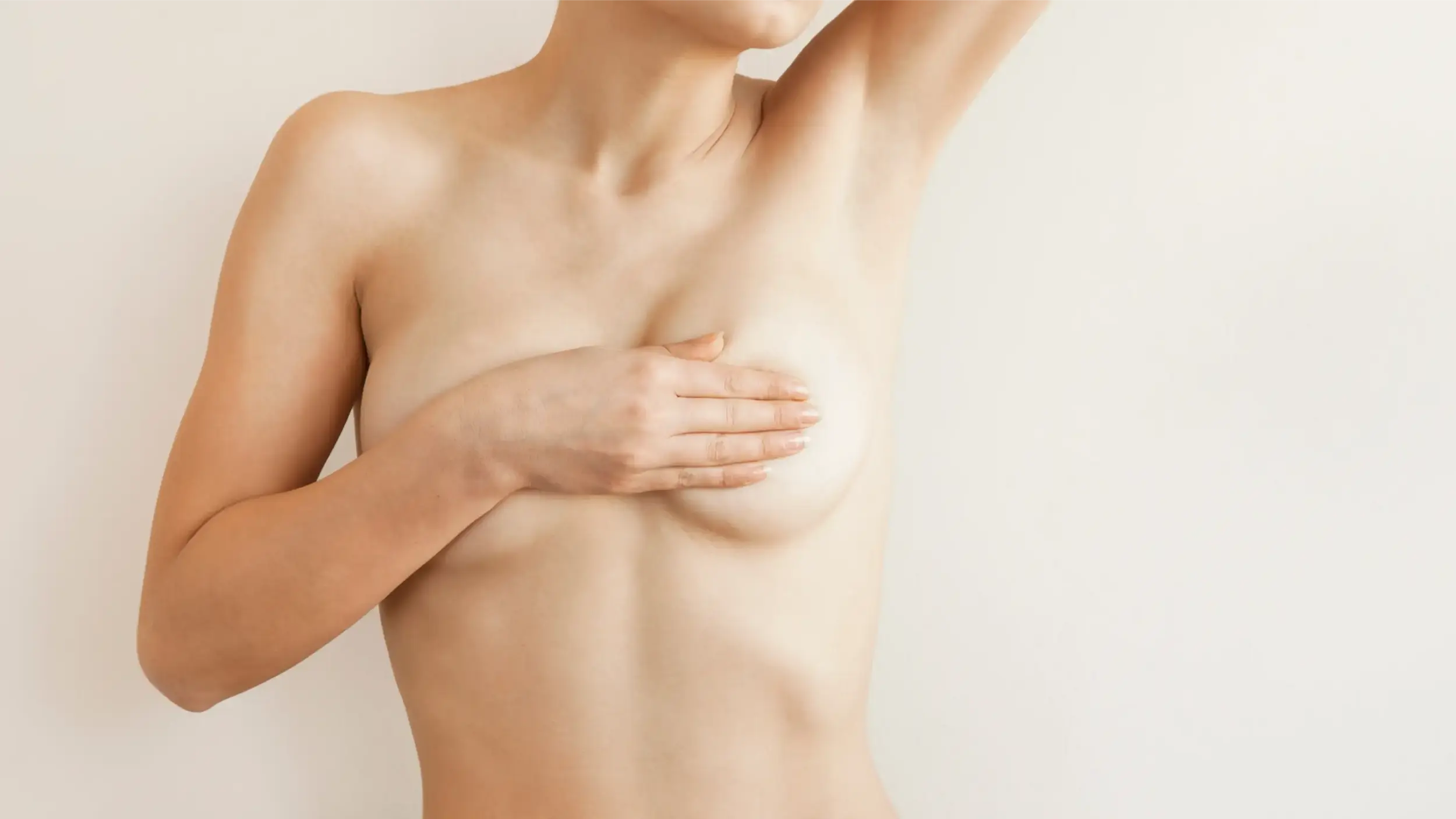
After significant weight loss, the breasts often lose volume, especially in the upper portion, and excess skin remains. A breast lift (mastopexy) tightens the skin, lifts the tissue, and reshapes the breast. Whether an implant or fat transfer is the best option depends on your specific findings and is planned on an individual basis.
The breast consists of glandular tissue, fatty tissue, and skin. People who lose a significant amount of weight primarily lose fatty tissue. The volume decreases, while the skin, as the surrounding envelope, does not shrink to the same extent. This results in excess skin.
Review articles describe the typical consequences of massive weight loss: The breasts can sit lower (ptosis), and lose fullness in the upper region. A review in Ugeskrift for Læger (2022) also lists possible physical complaints, such as skin inflammation in skin folds (intertrigo), as well as psychological distress. As a result, many affected individuals express a desire for corrective surgery.
In everyday life, this manifests in various ways. Some women report a lower-positioned nipple, while others experience friction and skin irritation in the inframammary fold or have difficulty finding clothing and bras that fit properly. These symptoms are a reason to have the situation evaluated by a doctor. However, they are no substitute for an examination: Your specialist will determine whether surgery is appropriate based on your medical findings.
This phenomenon affects women who have lost weight through dieting as well as those who have undergone bariatric surgery—that is, stomach surgery for weight loss, such as a gastric bypass. A similar change can also occur after weight loss achieved with medication. What matters is not the method, but the extent and speed of weight loss, as well as the quality of the skin.
In short: Reduced volume and excess skin are the root causes. Together, these factors determine which surgical option is appropriate.
The skin is the key factor in maintaining a youthful, firm breast shape. Its elasticity depends, among other things, on age, genetic predisposition, smoking, sun exposure, and the how long the skin was stretched at a higher weight. The more the skin has been stretched, the less it will retract on its own after weight loss.
In terms of planning, this means that surgery can remove excess skin and reposition the tissue. However, how long the shape lasts depends largely on the quality of the tissue. For example, a Brazilian case series (Revista Brasileira de Cirurgia Plástica, 2014) observed that when an implant is covered by a skin flap, progressive ptosis can occur after about one year. Realistic expectations are therefore an important part of the consultation.
Dr. Limbourg’s practice describes one method for stabilization: a so-called internal bra can provide greater shape stability in cases of soft tissue or large breasts. The surgeon will determine during the consultation whether this is an option for you.
A breast lift should not be performed until your weight has stabilized. If the patient continues to lose or gain weight afterward, the breasts will change again and the results may be affected.
There is no standard timeframe for how long to wait. In the Brazilian case series mentioned above, the authors performed surgery no earlier than 18 months after gastric bypass surgery and required that the patient’s weight had been stable for at least six months. These figures are examples from a single study, not a rule that applies to every patient.
It is also important to make good use of the time leading up to the surgery. A balanced diet, sufficient protein, and a healthy lifestyle support wound healing. If necessary, seek nutritional counseling, especially after gastric surgery, as nutrient deficiencies can impair healing.
In practice, this approach has proven effective:
In short: A stable weight is the most important prerequisite. We’ll determine the waiting period together with you.
According to the practice, the appropriate method depends on your anatomy, skin type, and your preferences. Dr. Limbourg’s practice describes several incision techniques on its treatment page:
| Procedure | Incision Technique | Typical Use |
| Benelli (circular) | Incision around the areola | Mild excess skin; not suitable for large, sagging breasts |
| Vertical lift (Lejour / Hall-Findlay) | Around the areola and perpendicular to the inframammary fold | Especially for smaller breasts |
| T-incision (anchor technique) | Additionally, horizontally along the inframammary fold | Severely sagging breasts; most extensive reshaping |
After significant weight loss, excess skin is often pronounced. In such cases, more extensive techniques are often considered, which result in correspondingly longer scars.
Lift with Implant (Augmentation Mastopexy)
This approach combines a lift with volume restoration using an implant in a single surgery. Based on clinical experience, it is suitable when a fuller décolletage is desired. It requires careful planning because the implant and the overlying skin must be properly matched.
Lift with fat transfer
Here, lost volume is restored using the patient’s own fat. The practice highlights the ability to shape the breast with the patient’s own fat. This option can be considered after pregnancy, weight loss, or age-related tissue loss. A prerequisite is that there is sufficient fat tissue available for harvesting from other parts of the body. After significant weight loss, this is not always the case.
How Does 3D Simulation Help with the Decision?
According to the practice, a 3D simulation performed before surgery can show what the breasts might look like after the procedure. It serves as a basis for discussion to align patient wishes with what is medically feasible, but it is not a guarantee of a specific outcome. Especially after significant weight loss, when skin and volume vary greatly, clear planning facilitates a joint discussion of alternatives.
In short: The choice between a lift alone, implants, or fat transfer depends on the skin envelope, residual volume, and your goals.
After significant weight loss, excess skin rarely affects only the breasts. Often, the abdomen, upper arms, thighs, or back are also affected. Some patients therefore request a staged tightening of multiple body areas, such as a so-called body lift.
Whether procedures are combined—and in what order—is a decision made on a case-by-case basis by the physician. Factors such as longer surgery times, the overall strain on the body, and your health play a role in this decision. The practice offers treatments for the face, breasts, and body, allowing the various steps of the treatment plan to be coordinated.
Every breast lift leaves scars. Their length depends on the procedure chosen and ranges from a scar around the areola to an anchor-shaped scar. Scars typically fade over the course of several months. Sun protection, scar care, and avoiding smoking all support the healing process.
Dr. Limbourg’s practice estimates that a breast lift takes about two to three hours under general anaesthesia, requires an overnight hospital stay, and involves a recovery period of about one to two weeks. The procedure is performed in cooperation with the Sophienklinik Hannover. Possible risks include postoperative bleeding, wound healing complications, changes in sensation, and asymmetry. These are discussed in detail before every operation.
The final result will not be apparent until several months later. Even after that, the breasts will continue to change due to ageing, weight fluctuations, and gravity, which should be taken into account when setting expectations.
When is surgery not advisable?
As long as your weight is still decreasing or fluctuating, it is generally too early to proceed. Medical conditions that impair wound healing are also evaluated in advance. Your specialist will discuss this with you during the consultation.
How long do the results of a breast lift last?
It’s not possible to give a definitive timeframe. The longevity of the results depends on skin quality, weight stability, age, and gravity. Maintaining a stable weight and wearing a well-fitting, supportive bra during the healing phase will help preserve the results.
Can I continue to lose weight or become pregnant after the surgery?
Significant weight fluctuations after the procedure can alter the shape of your breasts again. This also applies to pregnancy and breastfeeding. Therefore, discuss your life plans openly with your surgeon in advance so that the timing of the surgery is appropriate.
What can I do to prepare for the consultation?
The following information is helpful:
Please feel free to bring any questions you may have. A thorough analysis of your medical history is the first step in any planning process.
After significant weight loss, loss of volume and excess skin are the most common reasons for seeking a breast lift. A stable weight, careful selection of the procedure, and realistic expectations form the foundation.
At Dr. Limbourg’s practice in Hanover, specialists in plastic and aesthetic surgery will personally advise you on your options. If you’re considering whether and when a breast lift might be right for you, we’d be happy to discuss your situation during a no-obligation consultation—without any pressure and at your own pace.
Ob Veränderung, Korrektur oder Neuanfang – wir nehmen uns Zeit für Sie. In einem persönlichen Gespräch klären wir gemeinsam, was möglich ist und was wirklich zu Ihnen passt. Einfühlsam, ehrlich und auf Augenhöhe. Vereinbaren Sie jetzt Ihren Beratungstermin in unserer Praxis in Hannover.