11.06.2026

Anne Limbourg, M.D., Assistant Professor
Board-Certified Specialist in Plastic and Aesthetic Surgery
The tip of the nose is often the reason why patients consider rhinoplasty in the first place. A tip that is too wide, drooping, or asymmetrical has a greater impact on the face than many realize. Yet correcting the tip of the nose is one of the most technically demanding procedures in rhinoplasty.
In this article, we explain what makes the tip of the nose so unique from a surgical perspective, which techniques are used, and why isolated tip correction is less appropriate than many patients initially assume.
In the majority of rhinoplasty procedures, the primary focus is on the tip of the nose—even when a nasal hump is removed or the nasal septum is straightened at the same time. Three factors make this area particularly challenging:
To understand what a tip rhinoplasty achieves, it helps to look at the anatomy. Central to this are the paired alar cartilages (Cartilagines alares majores), which give the tip of the nose its shape. They consist of three parts on each side: a central lobe, a dome area (the actual “dome”), and a lateral lobe extending toward the nostril.
For aesthetic analysis, rhinoplasty surgeons consider several parameters:
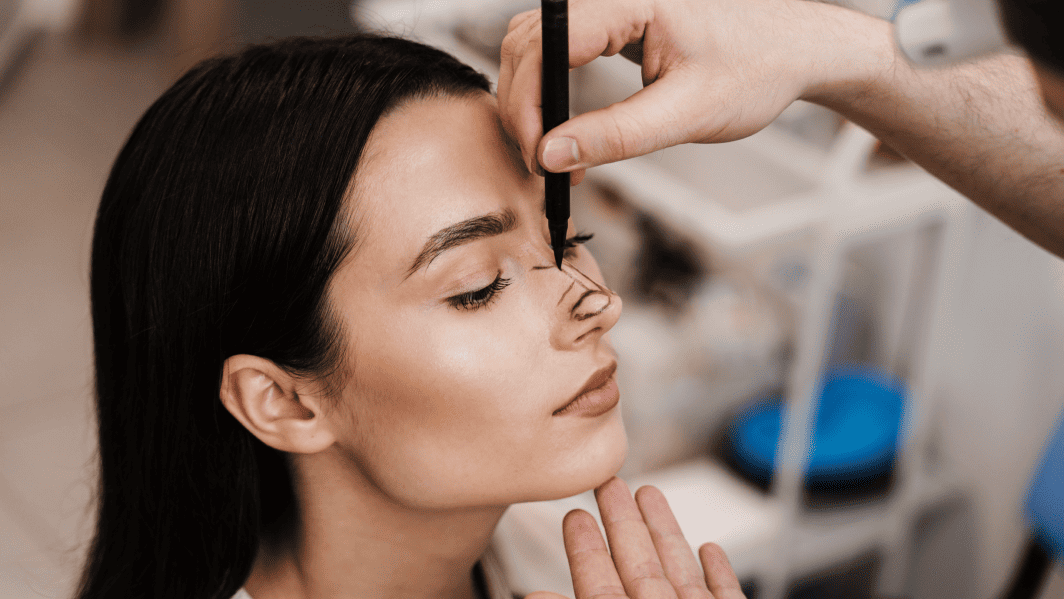
During our consultations, we frequently encounter three common concerns:
In the case of a bulbous (spherical) nasal tip, the alar cartilages are often strongly developed or widely spread. The tip appears rounded, lacking definition. Correction is usually achieved through gentle narrowing and reshaping of the alar cartilages—e.g., via dome sutures or targeted thinning of the lateral crura.
Drooping nasal tip
A plunging tip points downward—either at rest or more pronounced when smiling. Causes may include a weak septal framework, an overly long cartilaginous nasal septum, or certain muscle activities. Depending on the cause, correction requires shortening the septal cartilage, stabilizing the middle septum, and, if necessary, inserting a tip strut.
Asymmetries can be congenital or result from trauma. They are particularly challenging to correct surgically because they require very delicate cartilage adjustments. Cartilage grafts from the septum or the ear are often used to build up the weaker side.
There are two basic surgical approaches for tip rhinoplasty.
All incisions are made inside the nose. Healing is less noticeable, and there are no visible scars. The closed technique is well-suited for small, well-defined corrections and for patients with good anatomical visibility.
With the open technique, a small additional incision is made across the columella (the strip of skin between the nostrils). This provides a direct view of the cartilage structure. This approach is the method of choice for complex cases, pronounced asymmetries, revision surgeries, or the placement of structured cartilage grafts.
The choice of technique is always a case-by-case decision—it is based on the findings, the correction goals, and the surgeon’s experience.
One of the most important points to note upfront: The tip of the nose is not a modeling workshop. The extent of change that is possible depends on the existing cartilage structure, skin quality, and general healing conditions.
Honest consultation is part of our approach: We explain upfront what we can realistically achieve—and also where the limits lie. The 3D simulation (Crisalix®) helps us work with patients to develop realistic goals.

Many patients ask this question—and the answer is usually more nuanced than they hope.
The tip and bridge of the nose together form an aesthetic unit. Anyone who significantly alters the tip without adjusting the bridge risks creating a lack of harmony in the profile. A common example: If a drooping tip is rotated upward, a previously unremarkable nasal bridge may suddenly appear as a bump.
Nevertheless, there are cases in which isolated tip correction is appropriate:
An honest analysis is crucial: Isolated correction is possible—but only if it leads to a harmonious overall result.
The skin of the nasal tip is particularly thick and rich in sebaceous glands. This makes it biologically resilient, but also prone to scarring. Internal scarring may manifest as small bumps or asymmetries after correction. With targeted post-operative care—manual lymphatic drainage, small cortisone injections if necessary, and patience—most of these changes can be managed.
With the open technique, a small external scar also forms at the columella incision. It typically runs as a fine line that is practically invisible after a few months.
Nose tip correction requires an understanding of anatomy, surgical experience, and a high degree of sensitivity. Dr. Limbourg’s practice specializes in rhinoplasty, and we offer the full range of tip corrections—from subtle refinements to structured reconstruction following previous surgeries.
The tip of the nose is small—but it plays a decisive role in how a nose appears. Surgically altering it is challenging and requires experience, anatomical understanding, and surgical finesse. Isolated tip correction is possible, but in many cases it only makes sense if the issue is clearly defined and the bridge of the nose remains harmonious.
At our practice, we take the time for a precise analysis, an honest assessment, and 3D-assisted planning—so that the desire for a small change ultimately results in a harmonious overall outcome.
Ob Veränderung, Korrektur oder Neuanfang – wir nehmen uns Zeit für Sie. In einem persönlichen Gespräch klären wir gemeinsam, was möglich ist und was wirklich zu Ihnen passt. Einfühlsam, ehrlich und auf Augenhöhe. Vereinbaren Sie jetzt Ihren Beratungstermin in unserer Praxis in Hannover.